
Bellwether vs Traditional Robot Integration: Faster Factory Rollouts
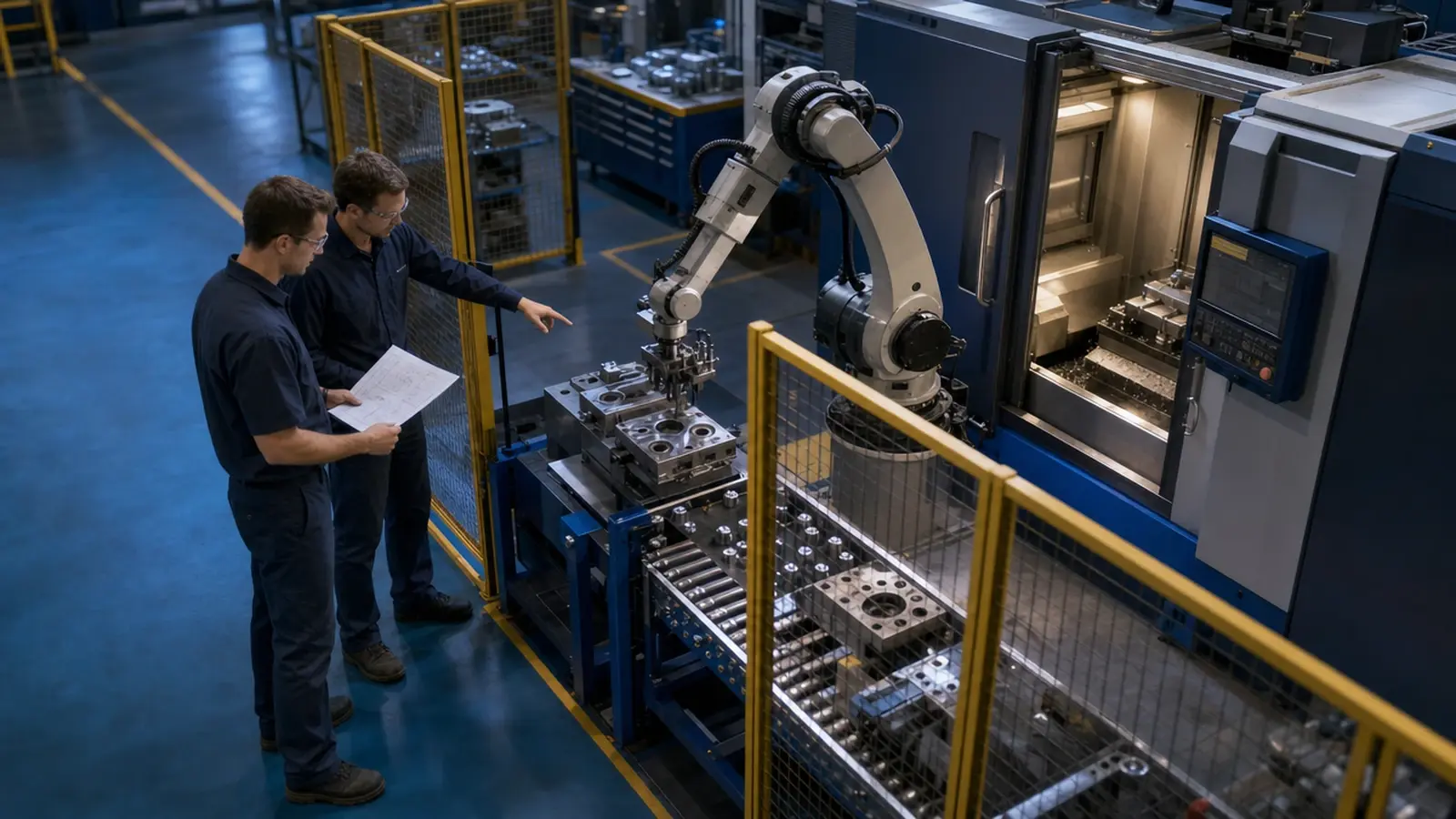
A new cell, a running line, and a launch date that won't move.
Robot integration is the work of fitting a robot into a real manufacturing process: mounting it, programming the task, connecting it to fixtures and plant systems, validating safety, and adjusting it as products and layouts change. A new product variant launches in six weeks. The robot cell that loads it is already running two other parts, and the fixture has to change. You call your integrator, and the earliest visit is after the launch date.
Many robot integration projects stall in that gap. The robot itself is usually the easy part. Programming, fixtures, safety review, and tuning take the time, and they happen on a line that is supposed to be making parts. Every change pulls in system integration effort, and every visit competes with production, which is why a better integration process can cut downtime, cost, and dependence on scarce on-site support.
For manufacturing engineers, production managers, plant operators, and factory leaders planning or managing industrial robot deployments, this post compares two ways to handle robot integration. One is the traditional, integrator-led project. The other is a simulation-first approach, where most of the building and testing happens in a virtual copy of the cell before anyone touches the floor. You'll see how digital twins and Sim2Real transfer fit into that workflow, how phased rollouts work, how to prepare your team, what to ask vendors, and how to judge deployment speed without trusting a single headline number.
Why Traditional Robot Integration Slows Automation Systems Factory Rollouts
Industrial robots have become easier to buy. Fitting them into a working plant has not. NIST notes that putting robots into existing facilities can be difficult and expensive, and that plants must keep reconfiguring as markets change [1]. These are common considerations, not claims about every site.
A Line That Can't Stop
Your plant runs to a schedule. Taking a cell offline for days of tuning means lost output or overtime later. Traditional robot integration often needs that floor time, because much of the programming and debugging happens on the real equipment.
Constant Product and Layout Change in Modern Manufacturing
New parts, new tolerances, and new packaging arrive all the time. Each one can mean another round of robot integration work. NIST has pointed out that the robot alone may be affordable, but the time for programming and installing it can be expensive, especially in short-run production [2].
The Cost of On-Site Trial and Error
When tuning happens on the floor, every mistake costs real parts and real hours. In robotic integration projects, that trial and error drives more scrap, downtime, and longer lead times, while automation reduces costs from labor, scrap, and downtime when issues are resolved earlier. A missed edge case may only show up on second shift. Many teams also find that a robot is at its best on commissioning day and drifts as the environment changes around it [3]. If that sounds familiar, our post on common robot deployment roadblocks covers the pattern in detail.
What Is Simulation-First Robotic Systems Integration?
Simulation-first robot integration means building and testing a robot's task in a virtual model of the cell before it runs on the real line. Engineers tune behavior, test edge cases, and fix problems at a desk. On-site time then focuses on validation and safety checks instead of trial and error.
The virtual model is often called a digital twin, an electronic representation of a real-world physical thing [4]. Sim2Real is the step that moves skills learned in simulation onto physical robots. Simulation offers far more practice data than a live line allows, with fewer safety risks [5].
The gap between simulated and real worlds can degrade performance when a policy moves to hardware [5]. Real cells have cables someone rerouted and fixtures that sit almost where the drawing says [6]. Simulation can reduce on-floor tuning, but it does not replace real-world validation, site-specific safety review, or human oversight.
| Traditional integration | Simulation-first integration | |
|---|---|---|
| Where tuning happens | On the live line, often during downtime | Mostly at a desk, in a virtual model |
| When edge cases are found | Often after go-live | Before the robot reaches the floor |
| Floor disruption | Long on-site programming visits | Shorter, focused validation visits |
| Adapting to product changes | New programming project each time | Update the model, retrain, verify |
| Who owns the know-how | Often the integrator | More of it stays with your team |
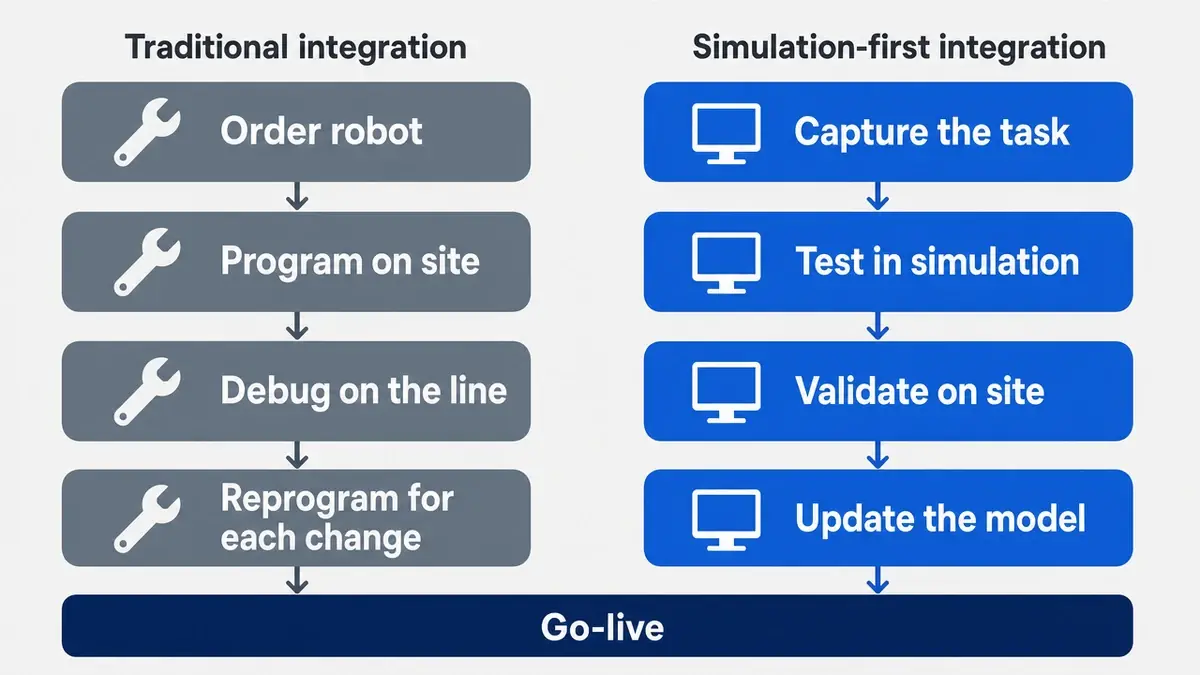
Simplified comparison. Real project timelines vary by site.
How Bellwether Approaches Robotic Integration
-
Capture the task with video, specs, and procedures.
-
Define the task and agree on what success means as teams work closely through the entire process.
-
Build and test the workflow in simulation, a simulation-first form of robotic systems integration that helps automate complex manufacturing processes effectively.
-
Deploy to one cell with on-site Sim2Real checks.
-
Collect data from real runs, retrain, and redeploy.
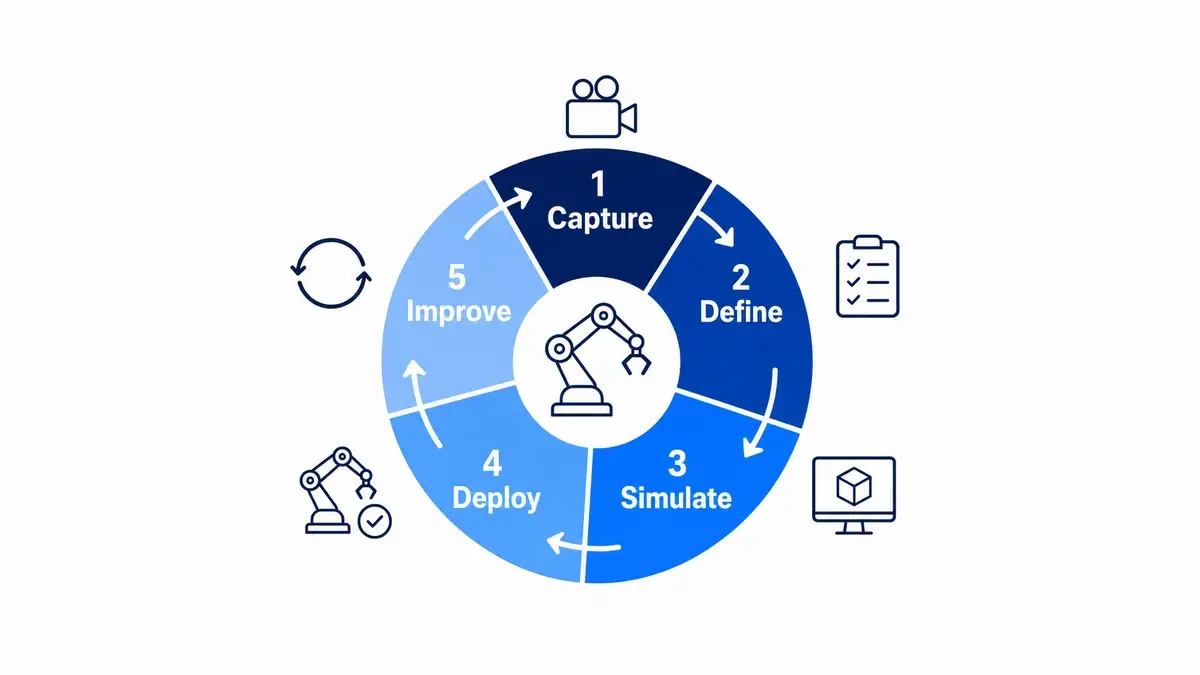
Capture, define, simulate, deploy, improve.
Capture the Task, Not Just the Robot Specs
Bellwether, 3GEN Robotics' rapid robot deployment and operations platform, starts with the job itself. You upload video of a person doing the work, plus machine specifications, product tolerances, and operating procedures [7]. That way, the robotics software starts from how the work is really done.
Define Success Before Development
Next, your team describes the task, documents production requirements, and agrees on performance goals. This step matters in any approach, and strategic planning is essential for justifying robotic investments. Unclear acceptance criteria are a common reason robot integration projects run long, because nobody can say when the cell is done, and Key Performance Indicators should measure throughput speed, error rates, and labor cost reductions.
Build and Stress-Test in Simulation
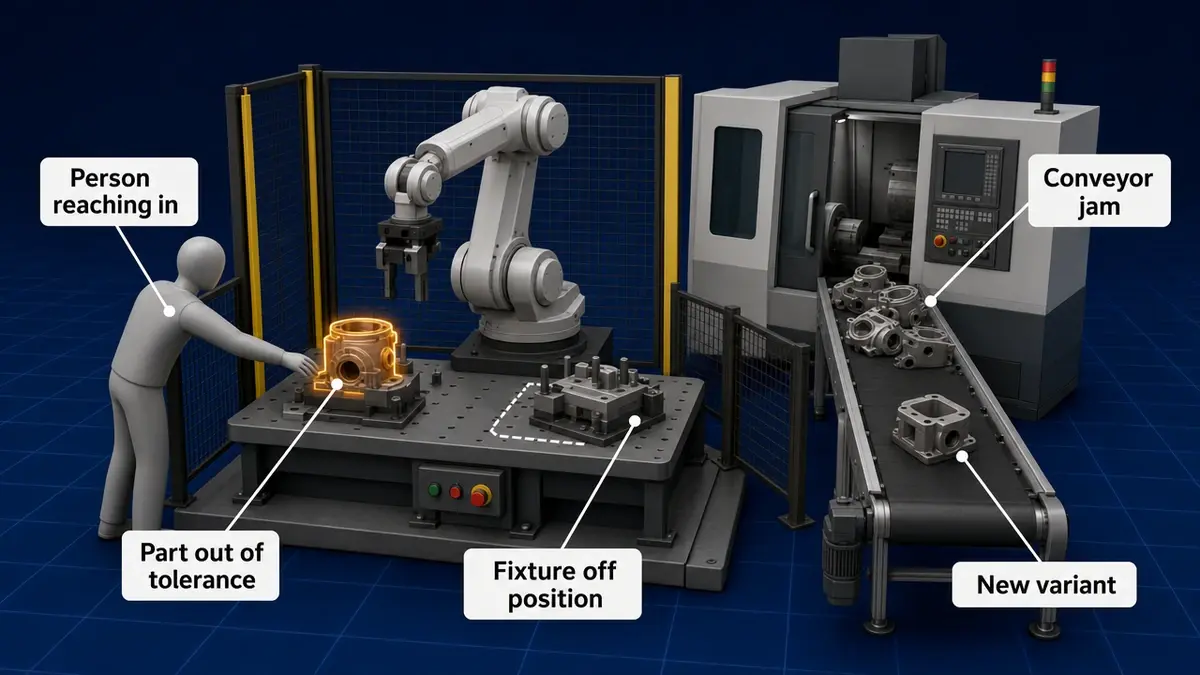
Bellwether's AI coding agents build a digital version of the task and test the workflow in simulation [7], including integrated vision systems that let robots perceive their environment visually and sensors that provide real-time data for robotic systems. That is where you stage the surprises on purpose:
-
A part that arrives slightly out of tolerance
-
A fixture that sits a little off its expected position
-
A conveyor jam that backs parts up into the cell
-
A person reaching into the cell during a cycle
-
A new product variant mixed into the run
This testing helps automated systems handle repetitive tasks with higher precision and fewer errors before deployment.
That way, your team finds most problems at a desk while the line keeps running.
Transfer With Sim2Real Checks on Site
No simulator matches a real cell exactly [6]. Plan on-site validation before the robot runs unattended. The on-site safety review should cover the complete application and follow standards such as ISO 10218 or RIA TR15.06 where collaborative workspaces apply. Expect small adjustments. They are a normal part of Sim2Real tuning and operator access during validation.
Keep Improving After Go-Live
Traditional projects often end at handoff, without ongoing support to sustain peak performance and durability after deployment. Bellwether is built around a cycle: define, simulate, deploy, collect data, train, improve, and redeploy [7], using real-time telemetry and predictive maintenance tracking for continuous monitoring, with cloud integration to scale updates across cells. Real runs feed the next round of training, so the cell keeps adapting as parts and layouts change. Our post on managing continuous retraining for deployed robots covers how to run that loop well.
Weighing a new robot cell or a change to an existing one? Request a demo to see how a simulation-first approach would handle your task.
An Integration Comparison: Where Each Approach Fits
A fair integration comparison starts by separating the jobs involved. Most factory projects include several layers:
-
Physical installation: mounting, guarding, wiring, and fixtures. This still needs skilled hands on site.
-
Controls and system integration: connecting the cell to PLCs, conveyors, and plant systems through control systems, with communication to existing Warehouse Management Systems and Enterprise Resource Planning software where needed.
-
Robot behavior: the programming or trained policy that decides how the robot does the task, while the robotic arm and end of arm tooling remain essential parts of the broader system.
-
Operations after go-live: updates, retraining, and changes as products evolve.
Traditional robot integration covers all four, and many integrators do it very well. A simulation-first platform focuses on the last two. Bellwether aims to let teams deploy without relying on a traditional systems integrator for every deployment [7]. How it connects to your PLCs and plant systems is something to confirm for your site.
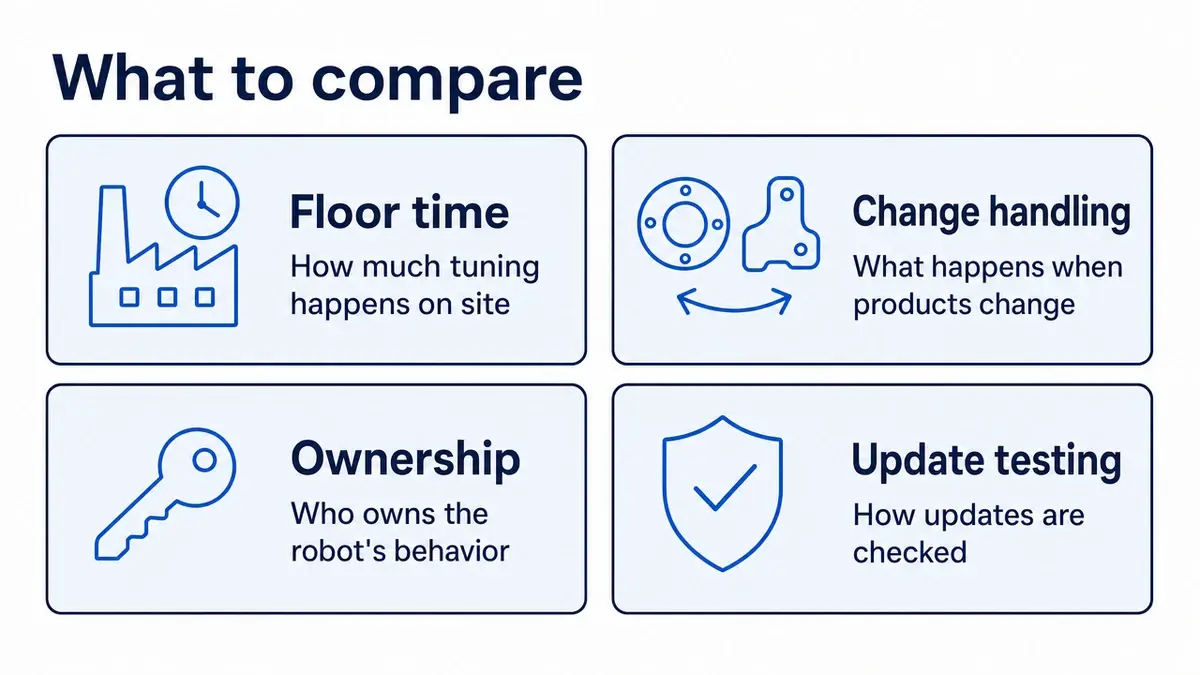
When you judge deployment speed, ask vendors questions like these:
-
How much of the tuning happens on our floor, and how much before arrival?
-
What happens when we add a product variant next quarter?
-
Who owns the trained behavior and the simulation model?
-
How are updates tested before they reach a running cell?
For a broader view of readiness, see our checklist for preparing your facility for autonomous robot operations.
A Hypothetical Factory Rollout, One Cell at a Time
Imagine a mid-sized plant planning robot integration for machine loading across three lines. This is a hypothetical example.
The team records operators loading parts and gathers the part specs and procedures. In simulation, they test jams, off-position fixtures, and mixed variants. They fix weak behaviors at a desk instead of during a shift.
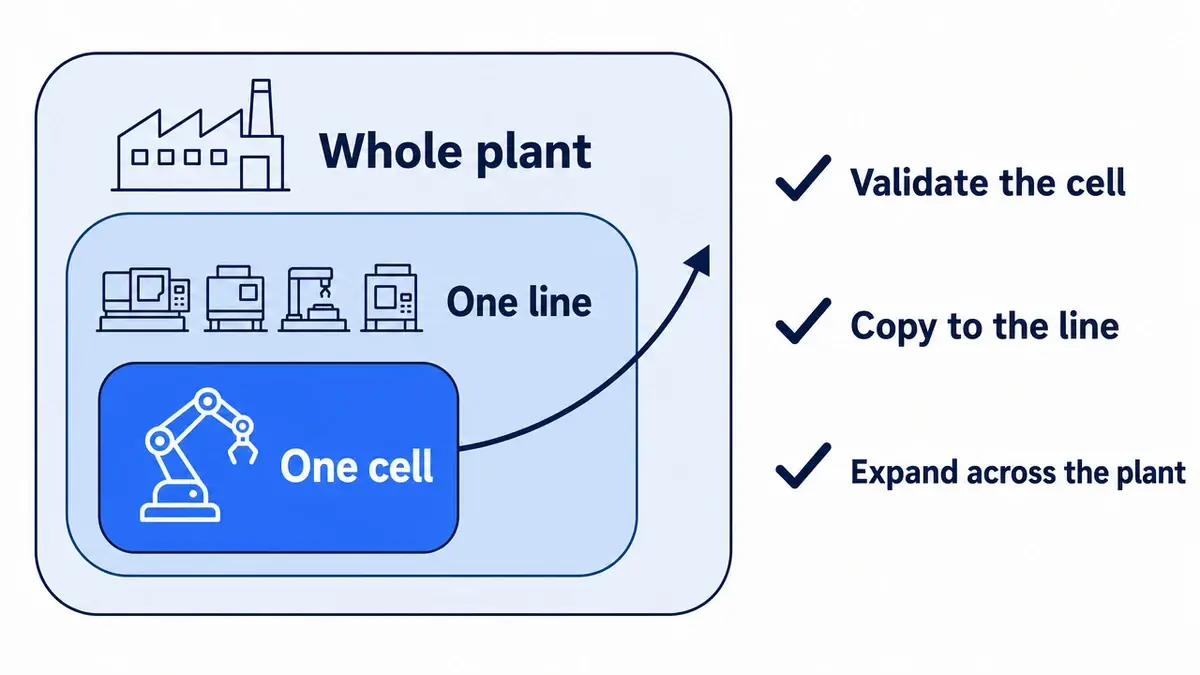
Next, they deploy to one cell on one line. On-site checks show small differences from the model, so they tune with Sim2Real feedback before the cell runs a full shift. Supervisors log each exception and who handled it.
Only after that cell holds steady do they copy the approach to the next line. When engineering releases a new part, they update the model and retest before it reaches the floor. Our guide to speeding robot deployment in busy facilities shows how phased rollouts fit a live building, and scaling robotic fleets without downtime covers what comes after the first cells.
Preparing Your Team for Robot Integration
Software moves much of the work to a desk, and you still need people who understand the line. Whichever approach you choose, these steps help:
-
Involve operators early. They know the jams and workarounds that never reach a drawing.
-
Name an internal owner. Someone should own the robot's behavior after go-live.
-
Plan safety for each cell. Review guarding, shared spaces, and stop procedures with your safety lead, and complete a risk assessment using standards such as ISO 10218 or RIA TR15.06 for collaborative workspaces.
-
Assign exception handling. Define who interacts with the system during normal production, setup, cleaning, maintenance, and fault recovery, and who responds when the robot stops, by shift.
-
Write down go-live criteria. Agree on what "ready for production" means before the first visit.
Simulation and robotics software do not replace sound operations planning or site-specific safety procedures. For shared spaces, review these safety protocols for introducing robots to humans.
Frequently Asked Questions
What is robot integration?
Robot integration is the work of fitting a robot into a real process. It covers mounting and guarding, connecting the robotic arm with machines and plant systems, integrating end of arm tooling, sensors, and vision systems into a complete system, programming or training its behavior, and validating it safely on site; vision systems enable robots to perceive their environment visually, sensors provide real-time data for robotic systems, and robotic arms and end-effector tools are essential components. It also includes the changes needed later, when products, fixtures, layouts, or the broader manufacturing process change.
Do I still need a systems integrator with a simulation-first approach?
Often, yes, for some of the work. Systems integrators bring the expertise to plan automation systems and handle physical installation, guarding, electrical work, and safety review, which helps automate complex manufacturing processes effectively and enhance manufacturing efficiency through strategic planning. A simulation-first platform aims to reduce how often you need outside help to build and change the robot's behavior, but robotic systems integrators often support the full lifecycle, including ongoing support after installation to ensure peak performance and durability, so more of that knowledge stays with your own team. That can still leave a valuable role for a robotic integrator when you need customized deployment and support.
Does simulation remove the need for real-world testing?
No. Simulation can reduce on-floor tuning, but no virtual model captures every detail of a real cell. Part variation, material flow, lighting, sensor noise, and small fixture shifts all differ from the model. Plan for on-site validation, a phased rollout, and a safety review of the complete application before the robot runs in production.
How should I compare deployment speed between vendors?
Ask where the time goes as well as how long the project takes. Compare how much tuning happens on your floor, how product changes are handled, who can make updates, and how vendors account for cycle time and Key Performance Indicators such as throughput speed, error rates, and labor cost reductions. A short first install matters less if every later change needs a new project and another site visit, and better deployment speed should also be judged by whether the approach helps optimize cost, scrap, and downtime over time.
Key Takeaways
-
Traditional robot integration often puts much of the tuning for different processes on the live line, where time is expensive.
-
Simulation-first integration moves building and testing to a desk, with on-site time for validation, and can support robotic solutions across automotive for spot welding, painting, and assembly; food and beverage for packaging and sanitary processing; healthcare and pharmaceuticals for medication dispensing and surgical assistance; and logistics and warehousing with automated guided vehicles for order fulfillment.
-
Physical installation and safety review still need skilled people, whichever approach you choose.
-
Judge vendors on floor time, change handling, and ownership rather than a single speed claim.
The right choice for robot integration depends on how often your products change and who you want to own the know-how.
See a Simulation-First Approach on Your Own Task
If you are planning a new cell or tired of waiting on changes, the 3GEN Robotics team can walk you through how Bellwether would approach your task. We'll keep it practical and specific to your line.
References
[1] National Institute of Standards and Technology. "Robotic Systems Interoperability and Integration." NIST, updated March 26, 2025. https://www.nist.gov/programs-projects/robotic-systems-interoperability-and-integration
[2] Wilkins, Tab. "A Robot In Time Saves." NIST Manufacturing Innovation Blog, February 20, 2014. https://www.nist.gov/blogs/manufacturing-innovation-blog/robot-time-saves
[3] 3GEN Robotics. "The Robot Is the Easy Part: Why Deployment and Operations Decide Automation ROI." 3GEN Robotics Blog, August 19, 2026. https://www.3genrobotics.com/blogs/robot-deployment-and-operations-platform
[4] National Institute of Standards and Technology. "Security and Trust Considerations for Digital Twin Technology (NIST IR 8356)." NIST Computer Security Resource Center, February 14, 2025. https://csrc.nist.gov/News/2025/nist-releases-nist-ir-8356
[5] Zhao, Wenshuai, Jorge Peña Queralta, and Tomi Westerlund. "Sim-to-Real Transfer in Deep Reinforcement Learning for Robotics: A Survey." IEEE Symposium Series on Computational Intelligence (SSCI), 2020. https://arxiv.org/abs/2009.13303
[6] 3GEN Robotics. "Understanding Sim-to-Real: Why Simulation-Trained Robots Fail in Real Buildings." 3GEN Robotics Blog, August 18, 2026. https://www.3genrobotics.com/blogs/understanding-sim-to-real-gap-robotics
[7] 3GEN Robotics. "Bellwether: Rapid Robot Deployment & Operations Platform." 3GEN Robotics, 2026. https://www.3genrobotics.com/bellwether